
Editorial note: This article compares Synceipt to YNAB (You Need A Budget), a product of YNAB LLC. YNAB is a trademark of YNAB LLC, used here only to identify and describe their product for comparison purposes. This comparison is independent editorial content, not sponsored by, affiliated with, or endorsed by YNAB. We've made a good-faith effort to verify every claim about YNAB against primary and official sources — cited at the bottom of this article — as of July 2026, but pricing, plan names, and features change frequently and may have changed since publication. We provide this comparison for informational purposes only, without warranty of completeness or accuracy, and it shouldn't be your only source before making a purchasing decision — verify current details at ynab.com first. Spot something that's wrong or out of date? Email support@synceipt.com and we'll correct it.
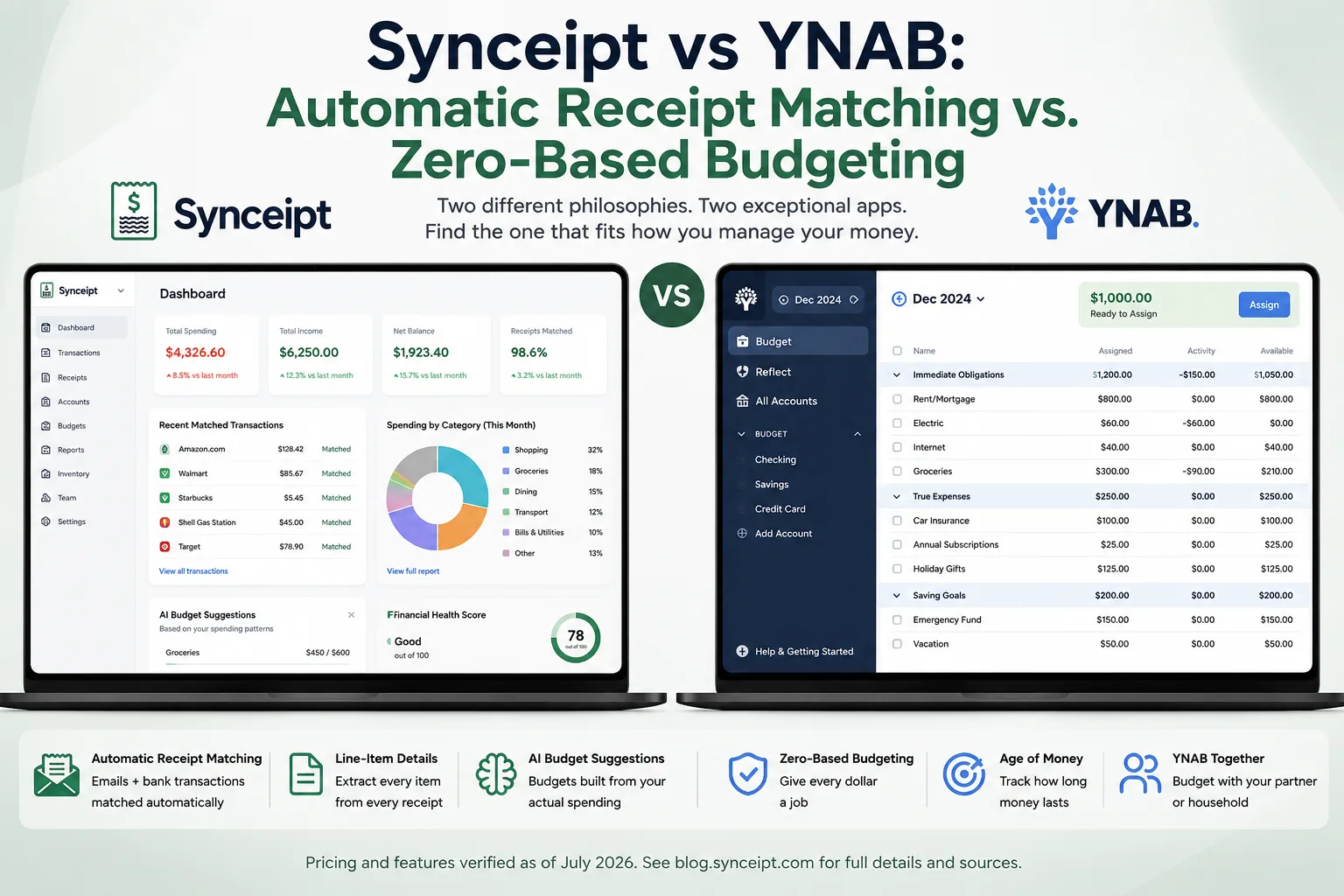
Of every comparison on this blog, Synceipt and YNAB are probably the furthest apart in philosophy. YNAB has no receipt features of any kind — it's entirely about a budgeting methodology. Synceipt has no budgeting methodology of its own — it's entirely about automatically verifying what you actually bought. That makes this less a head-to-head and more a question of which problem you're trying to solve.
YNAB is built around zero-based budgeting: four specific rules for deciding, in advance, where every dollar you earn is going to go. It doesn't read receipts, doesn't extract line items, and its bank-sync feature ("Direct Import") exists to bring transactions in so you can categorize them against a budget you already built — not to verify a purchase against a receipt.
Synceipt is built around a different pipeline entirely: read receipts from your email inbox automatically, sync bank transactions automatically, and match the two so every charge has a verified paper trail — then build item-level budgets and spending insights on top of that matched data, with AI-suggested targets instead of a manual monthly-allocation ritual. This comparison lays out where the two actually overlap (bank sync, budgeting, net worth) and where one does something the other simply doesn't attempt.
Synceipt vs YNAB at a Glance
| Feature | Synceipt | YNAB |
|---|---|---|
| Automatic email receipt import (Gmail, Outlook, Yahoo) | ✅ Yes — OAuth, zero action per receipt | ❌ No — no email or inbox receipt feature exists |
| Photo receipt capture with line-item extraction | ✅ Yes — AI extracts every line item, not just the total | ❌ No — photo attachment is reference-only, no OCR |
| Automatic receipt-to-transaction matching | ✅ Yes — exact amount, merchant, and date | ❌ No — YNAB has no receipts to match against transactions |
| Bank sync | ✅ Yes — Plaid, 12,000+ institutions | ✅ Yes — "Direct Import" via Plaid and MX |
| Item-level (line-item) budget categorization | ✅ Yes, automatic | ⚠️ Partial — manual transaction splitting only, no line-item detection |
| Zero-based budgeting ("Give Every Dollar a Job") / Age of Money | ❌ No | ✅ Yes — YNAB's core methodology |
| AI-generated budget suggestions from your own spending | ✅ Yes | ❌ No |
| Project & event budgets (trips, remodels, jobs) | ✅ Yes — dedicated Project Journal on paid plans | ❌ No — budgets are monthly categories only |
| Net worth tracking | ✅ Yes — automatic via linked accounts | ✅ Yes — Net Worth report, but investment/asset balances are manually updated |
| Household/family sharing | ✅ Yes — Pro (4) & Pro Plus (8+, expandable) | ✅ Yes — "YNAB Together," up to 6 people, no extra cost |
| Free plan | ✅ Yes — free forever | ❌ No — 34-day trial only (free year for verified students) |
| Starting price | $5.99/month | $14.99/month or $109/year (~$9.08/month) |
The Short Answer
- Choose YNAB if you want to adopt (or already follow) a strict zero-based, give-every-dollar-a-job budgeting discipline, and you're comfortable manually categorizing transactions and occasionally splitting receipts by hand.
- Choose Synceipt if you want your receipts and bank charges automatically verified and matched with no manual data entry, plus AI-suggested budgets built from what you actually bought — including line-item detail no receipt-less app can offer.
- These solve different problems well enough that some people genuinely use both — YNAB for the budgeting method, Synceipt for verified receipt data — though that means paying for two subscriptions with no integration between them.
Is Synceipt a Good YNAB Alternative?
If you're searching for a YNAB alternative because the $14.99/month (or $109/year) price with no free tier feels steep, or because you want less manual categorization and no methodology to learn, Synceipt is a legitimate one — with an important caveat. It depends on whether YNAB's zero-based budgeting discipline itself is the reason you use YNAB, or whether you were mainly using it as a bank-sync-and-categorize tool. Synceipt automates the second job well; it doesn't attempt the first.
Who Synceipt works well for as a YNAB alternative:
- Anyone who wants automatic receipt verification and bank-transaction matching, not a proactive budgeting ritual
- Freelancers and small business owners who want deduction-ready expense records with verified receipts — plus, on Pro or Pro Plus, a light bookkeeping ledger with a chart of accounts and P&L export
- Households who want net worth tracked automatically across checking, savings, credit, loans, and investment/retirement accounts without manually updating balances
- Anyone who wants to start on a free-forever plan instead of a 34-day trial
- Anyone who found YNAB's manual transaction splitting and payee-based categorization more tedious than they wanted, and would rather have line items extracted automatically
Where Synceipt isn't a full replacement: if the Four Rules — Give Every Dollar a Job, Embrace Your True Expenses, Roll With the Punches, Age Your Money — are themselves the value you get from YNAB, Synceipt doesn't enforce that discipline. It also has no Age of Money metric, no manually-tracked non-financial assets (a house, a car, jewelry) folded into net worth, and no household-sharing model that scales to 6 people at no extra cost the way YNAB Together does.
What Each App Is Actually Built For
YNAB is a budgeting methodology first, with software built to enforce it. Money that arrives gets assigned to a category immediately; bank transactions import via Direct Import (or manual/CSV entry when a connection breaks) so you can categorize them against the budget you already built. A transaction is categorized as a whole unless you manually split it — YNAB has no receipt to compare against a charge, so there's nothing to "match" the way Synceipt uses the term.
Synceipt is a receipt-and-transaction verification platform first. It reads your email inbox automatically, syncs your bank transactions, and matches the two so every charge has a verified paper trail — then builds item-level budgets, tags, and net worth on top of that matched data, with AI-suggested targets instead of a rule you have to apply by hand every time money moves.
YNAB's Four Rules, Briefly
- 1
1. Give Every Dollar a Job
Every dollar of income is assigned to a specific category — rent, groceries, savings, debt — as soon as it arrives, until the unassigned balance hits $0.
- 2
2. Embrace Your True Expenses
Large, irregular costs (car repairs, annual insurance, holiday gifts) get broken into smaller monthly savings targets so they're never a surprise.
- 3
3. Roll With the Punches
Overspend in one category? Move money from another category to cover it — the budget adjusts, it doesn't get abandoned.
- 4
4. Age Your Money
The goal is to spend money that's at least 30 days old — income earned last month funding this month's spending. YNAB tracks this as a specific "Age of Money" metric.
None of this has an equivalent in Synceipt, by design. Synceipt doesn't ask you to decide where a dollar is going before you spend it — it verifies what you already spent, against a receipt, and files it into a budget category automatically. That's a genuinely different job than the Four Rules are solving, which is why this comparison is less about which app is "better" than about which problem you actually have.
Pricing, Side by Side
Pricing verified from YNAB's own pricing and support pages as of July 2026. Confirm current pricing at ynab.com/pricing before subscribing to either product.
- Synceipt Free — $0/month forever. 1 email account, manual bank statement upload, limited AI receipt extractions, manual transaction/receipt entry, budget tracking.
- Synceipt Regular — $5.99/month, no trial (a previous 14-day trial was retired). 2 email accounts, 2 Plaid bank connections, automatic matching, recurring bill tracking, inventory sale tracking.
- Synceipt Pro — $9.99/month, with a 30-day free trial (credit card required). 8 email accounts, 5 bank connections, advanced reporting, a light bookkeeping ledger with chart of accounts, P&L, and revenue-by-customer export, team sharing for up to 4 members, 30-day money-back guarantee.
- Synceipt Pro Plus — $19.99/month. 15 email accounts, 15 bank connections, unlimited tags, the same light bookkeeping ledger as Pro, team sharing for up to 8 members (expandable), priority support.
- YNAB — $14.99/month, or $109/year (about $9.08/month billed annually). One tier, no feature gating — every subscriber gets unlimited accounts, transactions, categories, full bank syncing, all reports, and YNAB Together household sharing for up to 6 people at no added cost.
- YNAB trial and discounts — a 34-day free trial with no credit card required (via ynab.com directly). Verified college students get a genuinely free full year via YNAB's college program. Former YNAB 4 (legacy desktop) users get a 10% lifetime discount on annual renewals.
YNAB's single tier makes this simpler than most comparisons on this blog: there's one price, and it's higher than every Synceipt tier except Pro Plus on a monthly basis (though YNAB's annual rate, at about $9.08/month, undercuts Synceipt's Pro tier). The bigger structural difference is that YNAB has no free tier for ongoing use at all — only a time-limited trial — while Synceipt's free plan has no expiration.
Receipt Capture and Bank Sync
This is the area with the least actual overlap — YNAB simply doesn't compete here, which is worth being precise about.
- Receipt capture — YNAB: none. A feature added around April 2026 lets you attach a photo to a transaction for your own reference, with no data extraction — you still type in the amount, payee, and category. Synceipt: automatically reads Gmail, Outlook, and Yahoo inboxes via OAuth with zero action required, and also supports photographing a paper receipt with full AI line-item extraction.
- Third-party workarounds — a handful of apps built on YNAB's public API (e.g. "Receipts for YNAB," a Telegram bot called "Snapt") add OCR-style receipt capture that then pushes a transaction into YNAB. These are independent, third-party tools layered on top of YNAB's API — not something YNAB builds or supports itself.
- Bank sync — YNAB: "Direct Import," powered by Plaid and MX depending on the institution, with OAuth authentication for some banks; YNAB maintains a dedicated troubleshooting guide for broken linked-account connections, plus a manual CSV/file-import fallback. Synceipt: Plaid connections to 12,000+ institutions, syncing automatically, plus a PDF bank statement AI-upload fallback available on every plan including free.
- Matching — YNAB: there's nothing to match against, since there's no receipt; a transaction simply gets categorized (automatically re-applying a payee's last-used category, or one of its 5 most recent categories on mobile) once it's imported. Synceipt: matches receipts to bank transactions on exact amount, merchant, and date, with a manual matching mode for edge cases.
- Manual splitting — YNAB: a "Split Transactions" tool with an "Auto-Distribute" helper that proportionally spreads a leftover amount (like sales tax) across categories you've already entered by hand. Synceipt: reads the actual line items on a receipt and assigns each one to a budget category automatically — no manual splitting step at all.
The practical test: with YNAB, a $135 Target run is one transaction you categorize (or split by hand) yourself. With Synceipt, the same receipt's line items are read automatically and sorted into Electronics, Cleaning Supplies, and Groceries without you touching it.
Budgeting and Net Worth
Both apps produce a budget and a net worth figure. How each one gets there is the real story.
- Budgeting model — YNAB: zero-based; every dollar of income is manually assigned to a category until nothing is left unassigned, with rollover balances and an Age of Money metric tracking how far your spending lags your income. Synceipt: AI-generated budget suggestions per category based on your own historical spending, applied automatically as receipts and transactions are matched — no manual monthly allocation step.
- Categorization depth — YNAB: whole-transaction by default, with manual splitting available. Synceipt: item-level by default — a single multi-category receipt is split automatically across the right budget categories.
- Net worth — YNAB: a Net Worth report combining regular accounts with manually-updated "Tracking Accounts" for investments, retirement, and other assets (a car, a house, jewelry) — genuinely broader in what it can include, but YNAB itself notes this requires "extra work to keep your data current." Synceipt: Account Balance Tracking syncs checking, savings, credit, loans, and investment/retirement balances automatically via Plaid, with a weekly net worth summary email — less manual upkeep, but no manual-asset tracking for things outside a linked account.
- Reports and export — YNAB: Spending, Net Worth, and Income vs. Expense reports, with CSV/TSV export of both reflection data and full plan/transaction history. Synceipt: budget, spending, and net worth views built into the app, with advanced reporting and export on paid plans, plus (Pro/Pro Plus) a light bookkeeping ledger that exports a P&L and revenue-by-customer report to Excel.
Features Synceipt Has That YNAB Doesn't
- Fully automatic email receipt capture with no manual scanning, uploading, or forwarding step
- Photo receipt capture with full line-item extraction, not just a reference photo
- Automatic receipt-to-transaction matching — YNAB has no receipts to match against a charge at all
- Item-level (line-item) budget categorization without manual splitting
- AI-generated budget suggestions based on your own spending history
- Project & event budgets — a dedicated Project Journal (paid plans) that groups a trip, remodel, wedding, or client job across categories and months, with linked transactions, a checklist, vendors, and a PDF export
- A light bookkeeping ledger (Pro & Pro Plus) — custom chart of accounts, deposit splitting into revenue/fees/tax, period close, and a P&L + revenue-by-customer export to Excel
- A wallet for tracking cash and gift card balances as real transactions
- Sale event tracking for personal resale (yard sales, eBay, Venmo/PayPal), linkable to the resulting bank deposit
- A genuine free-forever plan, versus YNAB's trial-then-subscribe model with no ongoing free tier
- Independently verified security: Synceipt completed the Cloud Application Security Assessment (CASA) Tier 2, reviewed by TAC Security, an App Defense Alliance authorized assessor
Features YNAB Has That Synceipt Doesn't
If any of these are the reason you use YNAB, Synceipt won't replace it — it isn't trying to compete here:
- The zero-based, "Give Every Dollar a Job" budgeting methodology itself, including Age of Money as a tracked, named metric
- Manually-tracked non-financial assets (a house, a car, jewelry, collectibles) folded into a Net Worth report
- Free household sharing for up to 6 people on a single subscription, at no added cost, regardless of plan tier
- A public API with an ecosystem of third-party add-on tools
- Native Apple Watch app support
- A long-established, dedicated budgeting community and extensive first-party educational content built specifically around its methodology
Who Should Choose Which
- You want to adopt strict zero-based budgeting and are willing to manually assign every dollar and categorize every transaction → YNAB
- You want free household budget sharing for up to 6 people on one subscription → YNAB
- You want manually-tracked assets like a house or car folded into your net worth report → YNAB
- You want receipts read automatically from your inbox and matched to bank charges with zero manual entry → Synceipt
- You want your budget to reflect what you actually bought at the line-item level, not a category you assigned by hand → Synceipt
- You want a free-forever option instead of a time-limited trial → Synceipt
- You're a freelancer or small business owner who also wants a light bookkeeping ledger (chart of accounts + P&L) → Synceipt Pro or Pro Plus
- You want net worth updated automatically from linked accounts without manually re-entering balances → Synceipt
These aren't really competing for the same job. YNAB is a budgeting discipline with software attached; Synceipt is an automatic verification pipeline with budgeting attached. If you need both — the discipline and the automation — running both is a legitimate (if more expensive) option, since there's no integration between them today.
Frequently Asked Questions
Can Synceipt replace YNAB?
Only if you don't specifically need YNAB's zero-based budgeting method. Synceipt automatically verifies and categorizes what you've already spent; YNAB is built around deciding where every dollar goes before you spend it. If that discipline is why you use YNAB, Synceipt won't replicate it. If you mainly want automatic receipt-to-transaction verification and item-level budgeting without manual entry, Synceipt is a legitimate, cheaper alternative.
Does YNAB have receipt scanning like Synceipt?
No. YNAB has no native OCR or receipt-reading. A photo-attachment feature (added around April 2026) lets you attach a reference photo to a transaction with no data extraction. Third-party apps built on YNAB's API add OCR-style capture, but that's not a YNAB feature. Synceipt connects directly to Gmail, Outlook, or Yahoo and extracts full line-item detail automatically.
Which is cheaper, Synceipt or YNAB?
Synceipt has a free-forever plan and paid tiers from $5.99 to $19.99/month. YNAB has no ongoing free tier — only a 34-day trial — and costs $14.99/month or $109/year (about $9.08/month annualized).
Does Synceipt do zero-based budgeting like YNAB?
No. Synceipt's budgeting is AI-suggested and item-level, generated from your own spending history, without requiring you to assign every incoming dollar to a category first. It has no Age of Money equivalent — it's a reactive, automatic model rather than YNAB's proactive, manual one.
Can I use Synceipt and YNAB together?
Not directly — there's no integration between them. Some people manually re-enter or export data between the two, but that means two subscriptions and double categorization. Most people are better served choosing one based on their primary need: budgeting discipline (YNAB) or automatic receipt verification (Synceipt).
Does YNAB track net worth?
Yes, via a Net Worth report combining regular accounts with manually-updated Tracking Accounts for investments and other assets — but YNAB notes this takes extra manual upkeep. Synceipt's Account Balance Tracking syncs balances automatically via Plaid with a weekly summary email, though with less manual-asset detail than YNAB.
Which is better for someone who's never budgeted before — Synceipt or YNAB?
YNAB teaches a specific budgeting discipline that changes spending behavior, with a real learning curve and ongoing manual effort. Synceipt is closer to autopilot — it automatically verifies purchases and organizes them into AI-suggested budget categories without requiring you to adopt a new money-management method.
Try Automatic Receipt Matching Free
Connect your inbox and bank account once. Synceipt reads receipts and matches them to your bank transactions automatically from that point forward — no budgeting method to learn, no manual splitting, no learning curve.