
Editorial note: This article compares Synceipt to Monarch Money, a product of Monarch Money, Inc. Monarch and Monarch Money are trademarks of Monarch Money, Inc., used here only to identify and describe their product for comparison purposes. This comparison is independent editorial content, not sponsored by, affiliated with, or endorsed by Monarch Money. We've made a good-faith effort to verify every claim about Monarch against primary and official sources — cited at the bottom of this article — as of July 2026, but pricing, plan names, and features change frequently and may have changed since publication. We provide this comparison for informational purposes only, without warranty of completeness or accuracy, and it shouldn't be your only source before making a purchasing decision — verify current details at monarch.com first. Spot something that's wrong or out of date? Email support@synceipt.com and we'll correct it.
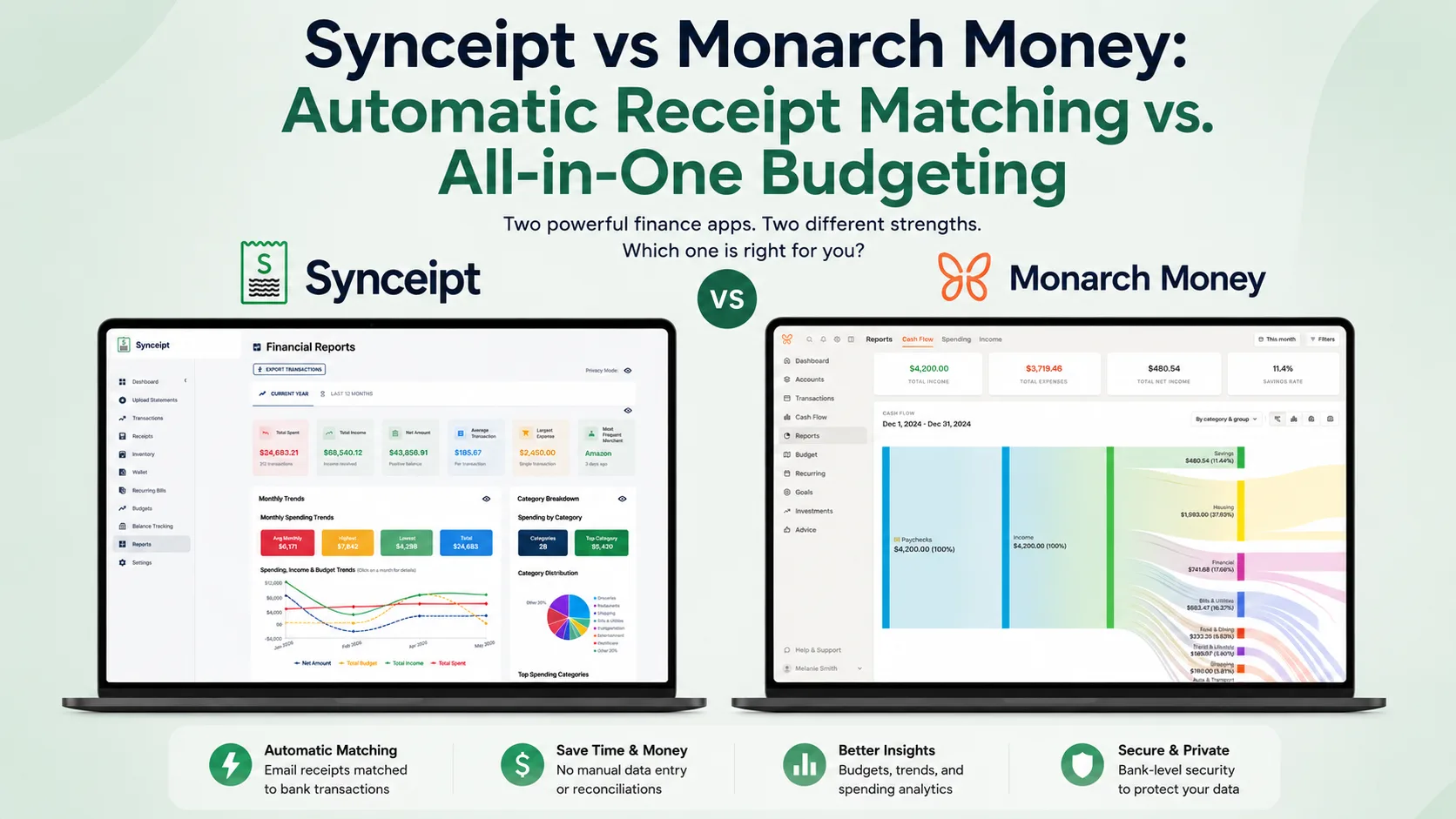
If you're deciding between Synceipt and Monarch Money, the biggest difference is simple: Monarch is built around budgeting and net worth across your entire financial picture, while Synceipt is built around automatically matching email receipts with bank transactions and using that verified purchase data to power item-level budgets and spending insights.
Monarch Money has earned its reputation as one of the best all-in-one personal finance apps available since Mint shut down — a single net-worth dashboard covering checking, credit, investments, retirement accounts, and even manually tracked assets like a house or a car. It's genuinely strong at answering “what is my overall financial picture and how is it trending.”
Synceipt answers a narrower, different question: “did this specific charge on my bank statement actually match what I was supposed to be charged, and what did I actually buy?” It's built around automatic email receipt capture and exact matching against bank transactions — a layer of verification most budgeting apps, including Monarch, don't fully automate yet. Synceipt also rolls your linked accounts into a net worth figure, but that's a secondary layer built on top of its core job, not the main event the way it is for Monarch. This comparison lays out where the two overlap and where they diverge, honestly.
Synceipt vs Monarch Money at a Glance
| Feature | Synceipt | Monarch Money |
|---|---|---|
| Automatic email receipt import | ✅ Yes — OAuth, zero action per receipt | ❌ No — manual upload or photo per receipt (forwarding planned) |
| Automatic receipt-to-transaction matching | ✅ Yes — instant on match | ✅ Yes — AI-assisted, with a “waiting for match” queue |
| Item-level (line-item) budget categorization | ✅ Yes | ⚠️ Partial — can split by category when applicable |
| AI-generated budget suggestions | ✅ Yes | ❌ No — manual/rules-based budgeting |
| Project & event budgets (trips, remodels, jobs) | ✅ Yes — dedicated Project Journal on paid plans | ❌ No — no per-project budget hub |
| Net worth tracking (checking, savings, credit, loans, investments) | ✅ Yes | ✅ Yes |
| Investment holdings-level detail and performance analysis | ❌ No — balance only | ✅ Yes (Morningstar-powered on Plus) |
| Retirement forecasting | ❌ No | ✅ Yes (Plus) |
| Business income ledger (chart of accounts + P&L export) | ✅ Yes — Pro & Pro Plus, light/single-entry ledger | ⚠️ Partial — business/rental income categorization only, no chart of accounts or P&L (Plus) |
| Equity/RSU compensation tracking | ❌ No | ✅ Yes (Plus) |
| Free plan | ✅ Yes | ❌ No |
| Starting price | $5.99/month | $14.99/month or $99.99/year |
The Short Answer
- Choose Monarch if your priority is holdings-level investment analysis, retirement forecasting, manually tracked assets (real estate, vehicles), and a mature all-in-one budgeting experience for a household.
- Choose Synceipt if your priority is automatic, hands-off receipt capture that gets matched to your bank transactions with no manual scanning, plus item-level budget accuracy and a lower price. Synceipt also tracks net worth across checking, savings, credit, loans, and investment/retirement accounts — just without Monarch's investment-analysis depth.
- Both apps do budgeting and bank sync well — the real difference is what each one automates completely versus partially, and how deep the investment/net-worth layer goes.
Is Synceipt a Good Monarch Money Alternative?
If you're looking for a Monarch Money alternative — because Monarch's 7-day trial ran out, its pricing feels steep for what you actually use, or you'd rather have receipts matched automatically than scan them in yourself — Synceipt is a legitimate one, with an important caveat: it depends on how much of what you use Monarch for is investment and net-worth depth versus budgeting and bank sync. Synceipt tracks net worth at the account-balance level and automates the one step Monarch still requires by hand: reading receipts from your inbox and matching them to bank transactions with zero manual scanning.
Who Synceipt works well for as a Monarch alternative:
- Anyone whose main use of Monarch is budgeting and bank sync, not deep investment analysis
- Freelancers and small business owners who want deduction-ready expense records with verified receipts — plus, on Pro or Pro Plus, a light bookkeeping ledger with a custom chart of accounts and P&L export — at a lower price than Monarch Core
- Households who want net worth tracked automatically across checking, savings, credit, loans, and investment/retirement accounts, without needing holdings-level detail
- Anyone who wants to start on a free-forever plan instead of Monarch's 7-day trial
- Anyone who's tired of manually uploading or photographing receipts one at a time
Where Synceipt isn't a full replacement: if you specifically rely on Monarch's holdings-level investment detail, retirement forecasting, credit score monitoring, equity/RSU compensation tracking, or manually tracked assets like a house or car, those don't have an equivalent in Synceipt today — you'd want to keep Monarch, or its Plus plan, for that layer.
What Each App Is Actually Built For
Monarch is a budgeting-and-net-worth platform first. Its core dashboard pulls together every account type you have — banking, credit cards, brokerage, 401(k), even crypto and manually entered assets — into one number: your net worth over time, with holdings-level investment detail layered on top. Budgeting, bill tracking, and receipt scanning are features layered onto that foundation.
Synceipt is a receipt-and-transaction verification platform first. It reads your email inbox automatically, syncs your bank transactions, and matches the two so every charge has a verified paper trail — then builds budgets, tags, and reporting on top of that matched data, down to the individual line item on a receipt. Its Account Balance Tracking feature also aggregates every Plaid-linked account — checking, savings, credit cards, loans, and investment/retirement accounts — into a net worth total, but Synceipt stops at the account balance; it doesn't break an investment account down into individual holdings the way Monarch does.
Pricing, Side by Side
Pricing verified from Monarch's help center, pricing page, and third-party coverage as of July 2026. Monarch runs periodic promo codes (30–50% off the first year); the numbers below are standard list pricing. Confirm current pricing at monarch.com/pricing before subscribing to either product.
- Synceipt Free — $0/month forever. 1 email account, manual bank statement upload, limited AI extractions, budget tracking, unlimited manual entry.
- Synceipt Regular — $5.99/month, no trial (a previous 14-day trial was retired). 2 email accounts, 2 Plaid connections, automatic matching, recurring bill tracking, item-level budgets.
- Synceipt Pro — $9.99/month, with a 30-day free trial (credit card required). 8 email accounts, 5 Plaid connections, advanced reporting, a light bookkeeping ledger with chart of accounts, P&L, and revenue-by-customer export, team sharing for up to 4 members.
- Synceipt Pro Plus — $19.99/month. 15 email accounts, 15 Plaid connections, unlimited tags, the same light bookkeeping ledger as Pro, team sharing for up to 8+ members, priority support.
- Monarch Core — $14.99/month, or $99.99/year (about $8.33/month billed annually). Unlimited account sync, budgeting, investment and net worth tracking, credit score monitoring, receipt scanning, household access.
- Monarch Plus — $199/year. Adds retirement/what-if forecasting, Morningstar investment analysis, business and rental income tracking, and equity/RSU tracking.
- Monarch offers a 7-day free trial on both plans; there is no free-forever tier.
For a single user, Synceipt's Regular plan ($5.99/month) is about 60% cheaper than Monarch's month-to-month price ($14.99) and still undercuts Monarch's discounted annual rate (about $8.33/month). For a household, Synceipt's Pro plan ($9.99/month, up to 4 members) comes in well below a single Monarch Core subscription billed monthly, though it runs slightly above Monarch's annualized rate — so the better deal depends on whether you're comparing month-to-month pricing or committing to Monarch's annual plan. Either way, Monarch's household access is bundled into every Core account regardless of member count, which is worth weighing if you have a larger family sharing finances.
Receipt Capture and Bank Matching
This is the sharpest point of difference between the two products, and it's worth being precise about it because Monarch's receipt feature is genuinely good — just not automatic in the same way.
- Capture method — Monarch: you open the app, select “Scan Receipt,” and photograph or upload each receipt individually (including screenshots or files saved from email, but you still have to save and upload them yourself). Synceipt: connects to your Gmail, Outlook, or Yahoo inbox via OAuth and reads purchase emails automatically — no per-receipt action at all.
- Email inbox connection — Monarch: does not connect directly to your email inbox as of this writing; Monarch has stated email forwarding is planned but wasn't available at the time of this comparison. Synceipt: this is the core feature — a direct, read-only OAuth connection to your inbox.
- Matching logic — Monarch: its AI extracts merchant, amount, and date from an uploaded receipt and searches for a matching transaction, including a “Waiting for match” queue that keeps checking as new transactions sync in. Synceipt: matches automatically on amount, merchant, and date the moment both the receipt and transaction exist in the system — no queue to check back on.
- Line-item detail — Monarch: can split a receipt into multiple transactions grouped by category (for example, groceries and household items) when applicable. Synceipt: extracts every line item on the receipt and assigns each one to a budget category automatically, so a single Amazon order accurately splits across Electronics, Groceries, and other categories without any manual review.
- Bank sync — both apps connect to banks via Plaid-class aggregation and sync new transactions automatically; this part of the pipeline is comparably strong on both sides.
The practical test: with Monarch, you still have to remember to scan or upload each receipt. With Synceipt, receipts get pulled in and matched in the background whether you open the app or not.
Budgeting, Net Worth, and Investments
Both apps will show you a net worth number. Where Monarch clearly leads is in what sits underneath that number — and it would be dishonest to frame it otherwise.
- Net worth tracking — Monarch: a dedicated, continuously updated net-worth dashboard across every linked account type, plus manually added assets like a house or car that aren't connected via Plaid. Synceipt: also tracks net worth — Account Balance Tracking aggregates checking, savings, CDs, credit cards, loans, and investment/retirement accounts synced automatically via Plaid, with a weekly net worth summary email — but it only covers linked accounts, not manually added assets.
- Investment tracking — Monarch: tracks individual holdings (stocks, mutual funds, 401(k)s, IRAs, ETFs, crypto) with allocation and performance detail, plus Morningstar-powered analysis on the Plus plan. Synceipt: syncs the balance of investment and retirement accounts into net worth, but doesn't break that balance down into individual holdings, allocation, or performance — Synceipt shows you the account is worth $42,000; Monarch shows you what's in it and how it's doing.
- Retirement planning — Monarch: “what-if” retirement forecasting on the Plus plan. Synceipt: no retirement planning tools.
- Credit score — Monarch: credit score tracking included on Core. Synceipt: no credit score monitoring.
- Budget categorization depth — Monarch: budgets by category or group, based on the merchant-level transaction (or a manual split when you use receipt scanning). Synceipt: budgets are driven by item-level receipt data automatically — the category assignment happens at the product level, not just the merchant level, without you manually splitting anything.
- AI budget suggestions — Synceipt: generates suggested budget amounts per category from your own historical spending, which you can accept individually or all at once. Monarch: budgeting is manual/rules-based; it does not generate full budget suggestions from your history the same way.
- Business income tracking — Monarch: categorizes recurring business or rental income within net worth and budgeting (Plus plan), but with no chart of accounts or P&L. Synceipt: on Pro and Pro Plus, a light bookkeeping ledger turns already-matched transactions into a custom chart of accounts, splits deposits into revenue/fees/tax, closes accounting periods, and exports a P&L and revenue-by-customer report — deeper structure for business income specifically, though still without Monarch's equity/RSU compensation tracking.
Features Synceipt Has That Monarch Doesn't
- Fully automatic email receipt capture with no manual scanning or uploading step
- Item-level (line-item) budget categorization, so multi-category orders split automatically without manual review
- A wallet for tracking cash and gift card balances as real transactions
- Sale event tracking for personal resale (yard sales, eBay, Venmo/PayPal), linkable to the resulting bank deposit or wallet balance
- AI-generated budget suggestions based on your own spending history
- Project & event budgets — a dedicated Project Journal (paid plans) that groups a trip, remodel, wedding, or client job across categories and months, with linked transactions, a checklist, vendors, and a PDF export
- A light bookkeeping ledger (Pro & Pro Plus) — custom chart of accounts, deposit splitting into revenue/fees/tax, period close, and a P&L + revenue-by-customer export to Excel, built directly on top of already-matched transactions
- PDF bank statement AI upload as a no-Plaid fallback for connecting an account
- A genuine free-forever plan
- Independently verified security: Synceipt completed CASA Tier 2, reviewed by TAC Security, an App Defense Alliance authorized assessor
Features Monarch Has That Synceipt Doesn't
If any of these are your primary need, Monarch (or a dedicated investment/net-worth tool) is the better fit — Synceipt isn't trying to compete here:
- Manually tracked assets (real estate, vehicles, collectibles) folded into net worth alongside linked accounts
- Investment holdings-level detail and portfolio performance analysis (Morningstar-powered on Plus) — Synceipt syncs investment account balances into net worth but doesn't break them into individual holdings or performance
- Retirement and “what-if” forecasting
- Credit score monitoring
- A household account model built in from the start, regardless of member count
- A more mature, dedicated budgeting interface refined specifically for category- and group-based budgeting over several years
Who Should Choose Which
- You want manually tracked assets (real estate, vehicles) and holdings-level investment analysis folded into your net worth → Monarch
- You're planning for retirement, want investment portfolio performance analysis, or need equity/RSU compensation tracking → Monarch
- You want net worth tracked automatically from your linked checking, savings, credit, loan, and investment accounts, without the extra manual-asset or holdings-analysis layer → Synceipt (and cheaper)
- You're a freelancer or small business owner who wants a simple, tax-ready P&L and chart of accounts without full double-entry accounting → Synceipt Pro or Pro Plus
- You want every receipt automatically captured and matched with zero manual scanning → Synceipt
- You want your budget to reflect what you actually bought at the product level, not just which store you shopped at → Synceipt
- You want a free-forever option before committing to a paid plan → Synceipt
- You track cash, gift cards, or resale income (yard sales, eBay, Venmo) as part of your finances → Synceipt
- You want the most established, feature-complete household budgeting app and don't mind manually handling receipts → Monarch
These aren't mutually exclusive goals — they're just different centers of gravity. Both apps will give you a net worth number. Monarch goes deeper on what's underneath it — holdings, allocation, performance, manually tracked assets, retirement forecasting. Synceipt goes deeper on what's underneath your spending — verified receipts, item-level budget accuracy, and full automation with no manual scanning.
Frequently Asked Questions
Does Synceipt track net worth and investments like Monarch?
Partially. Synceipt's Account Balance Tracking aggregates checking, savings, credit cards, loans, and investment/retirement accounts (401k, IRA, brokerage) via Plaid into a single net worth figure, plus a weekly net worth summary email. It doesn't do Monarch's deeper investment layer — holdings-level detail, allocation, performance analysis, retirement forecasting, or manually-added assets like a house or car. If that deeper investment picture is your priority, Monarch is the better fit.
Which is cheaper, Synceipt or Monarch Money?
Synceipt is cheaper at every tier, including a free-forever plan. Monarch has no free tier (only a 7-day trial) and starts at $99.99/year for Core, with Plus at $199/year.
Does Monarch automatically scan my email for receipts?
Not as of this writing. Monarch's receipt scanning requires you to upload or photograph each receipt yourself; email forwarding has been stated as planned but wasn't available at the time of this comparison. Synceipt connects directly to your inbox via OAuth and extracts receipts automatically with no per-receipt action.
Can couples or families share an account on Synceipt like on Monarch?
Yes, via Synceipt's team mode on Pro and Pro Plus plans, where the account owner invites members and sees everyone's transactions and matched receipts in one place. Monarch builds household sharing into its Core plan from the start regardless of member count.
Can I use Synceipt and Monarch together?
You can, but it means paying for and maintaining two apps with overlapping data. Most people are better served by choosing based on their primary need: Monarch for deep investment analysis and retirement forecasting, Synceipt for automatic receipt verification and item-level budgeting.
Which is better for freelancers or small business owners — Synceipt or Monarch?
It depends on what you're tracking toward. For automatic, deduction-ready expense records with verified receipts — plus, on Pro or Pro Plus, a light bookkeeping ledger with a chart of accounts and P&L export — Synceipt is purpose-built and costs less. For equity or RSU compensation tracking alongside personal net worth, Monarch's Plus plan covers that — Synceipt has no equivalent equity-compensation tracking.
Can Synceipt fully replace Monarch Money?
Only if net worth and investment tracking aren't your main goal. Synceipt covers net worth at the account-balance level but has no holdings-level investment detail, retirement forecasting, credit score monitoring, or manually-added assets like real estate. If those aren't priorities, Synceipt's automatic matching and item-level budgeting can replace what most people use Monarch for day to day.
Does Synceipt support Gmail, Outlook, and Yahoo receipt import?
Yes, all three, via read-only OAuth — this is Synceipt's core feature, and you can connect multiple email accounts at once. Monarch doesn't yet connect directly to any email inbox; its receipt scanning requires uploading or photographing each receipt.
Get Every Receipt Matched Automatically
Connect your inbox and bank account once. Synceipt reads receipts and matches them to your bank transactions in the background — no scanning, no uploading, no queue to check.