
Editorial note: This article compares Synceipt to features from OpenAI (ChatGPT, ChatGPT Finances, dots), Anthropic (Claude, Claude Duet) and Meta (Muse). These names are trademarks of their owners and are used here only to identify their products. This is independent editorial content, not sponsored by, affiliated with, or endorsed by any of them. Every claim about these products is sourced at the bottom of this article, using official help pages and announcements first and established news coverage second. It reflects what we could verify as of November 16, 2026. All three features are new and changing fast, so check current details with each provider. Spot something wrong or out of date? Email support@synceipt.com and we'll correct it.
Until this year, using an AI chatbot for your finances meant pasting in a spreadsheet and hoping. That changed in 2026. OpenAI launched Finances in ChatGPT in May. Meta launched its Muse agent with bank connections in September. Anthropic launched Personal Finance in Claude in November. All three link to your bank through Plaid, the same connection service Synceipt and many budgeting apps use.
So is a dedicated money app still worth it? It depends on which job you need done. These assistants are good at answering questions about your money in plain language. Synceipt does a different job. It collects the receipt behind each charge, matches the two, and turns them into records you can budget with, claim a refund with, or give to your accountant. Here is what each product does, and where each one stops.
The Short Answer
- If you want to ask questions about your spending in plain language ("why was October so expensive?" or "can I afford this trip?"), the AI assistants are built for that, and Synceipt isn't. Synceipt has no chat assistant over your data.
- If you want every receipt captured from your inbox and matched to its bank charge, kept as proof of purchase, and rolled into item-level budgets and tax-ready summaries, that is Synceipt's core job. None of the three AI finance features describe it in their documentation.
- If you want an agent to act for you, such as buying things, chasing subscriptions or negotiating bills, Muse, OpenAI's dots and Claude Duet are moving that way, each asking for your approval first. Synceipt never buys or moves anything. It keeps the record of what was bought.
- These tools work well together. Many people will ask an AI about their money and keep the receipts in an app built for that.
Side-by-Side Comparison
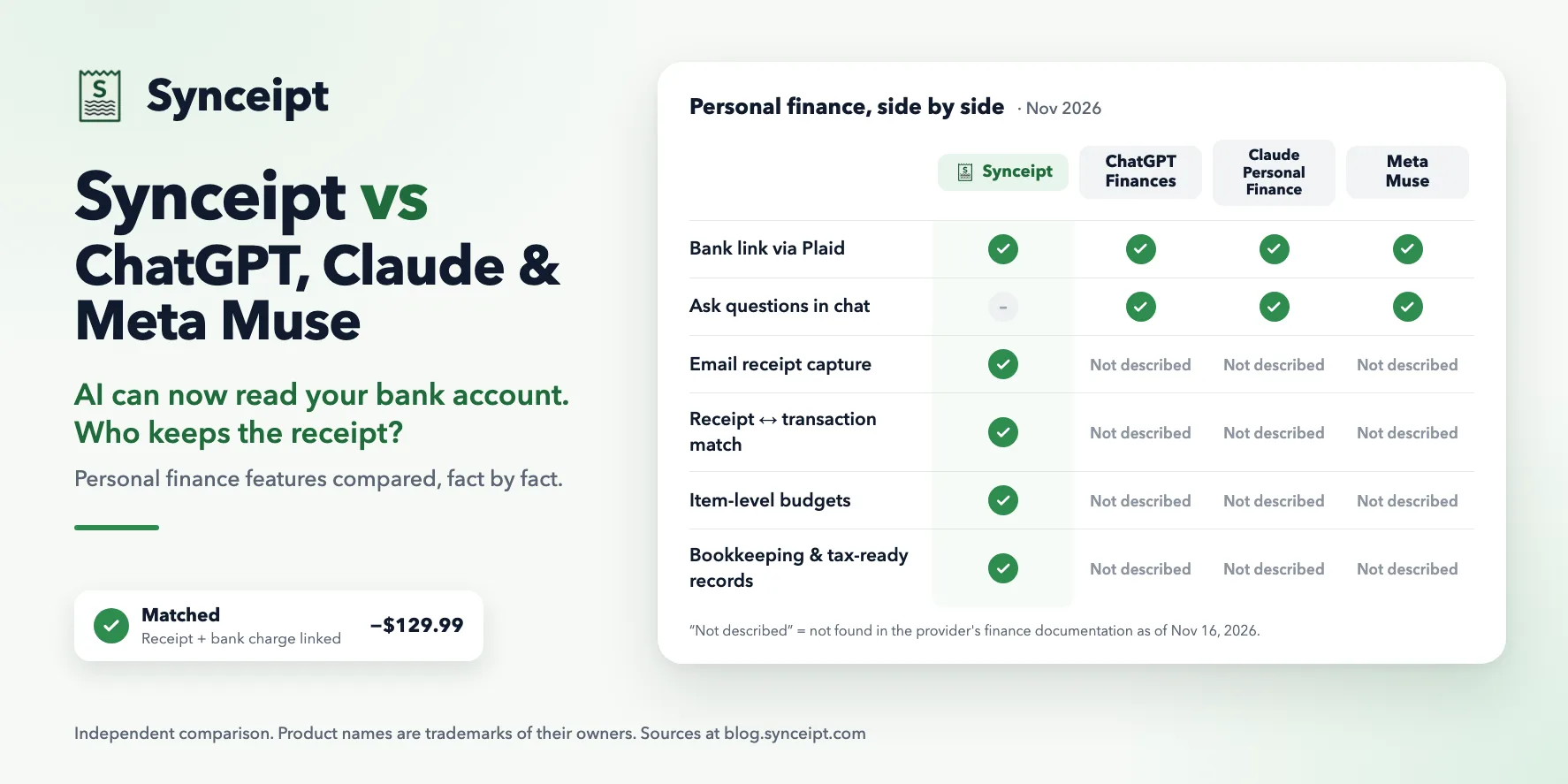
| Synceipt | ChatGPT Finances | Claude Personal Finance | Meta Muse | |
|---|---|---|---|---|
| Launched | Available now | May 2026 (preview) | Nov 2026 (beta) | Sep 2026 |
| Who can use it | Free plan + paid plans | US: Free, Go, Plus, Pro | US: Pro, Max, Ultra only | Not published; Plaid links US institutions |
| Bank connection | Plaid, or PDF statement upload | Plaid | Plaid (up to 16 banks) | Plaid, or upload a statement |
| Can it move money or buy things? | No, never | No, it can't take financial actions | No, read-only | Can act for you with approval, including purchases (as reported) |
| Plain-language Q&A about your money | ❌ No | ✅ Yes | ✅ Yes | ✅ Yes |
| Spending, subscriptions and bills overview | ✅ Yes | ✅ Yes | ✅ Yes | ✅ Yes (as reported) |
| Automatic email receipt capture | ✅ Gmail, Outlook, Yahoo | Not described | Not described | Not described |
| Receipt-to-transaction matching | ✅ Automatic | Not described | Not described | Not described |
| Item-level (line-item) budgets | ✅ Yes | Not described | Not described | Not described |
| Bookkeeping ledger, P&L and tax summaries | ✅ Pro and Pro Plus | Not described (can't file taxes) | Not described | Not described |
| Investment detail | Account balances only | Portfolio performance | Balances only, not holdings | Holdings can be shared |
ChatGPT Finances (OpenAI)
OpenAI launched Finances on May 15, 2026 as a preview for ChatGPT Pro subscribers in the US, about a month after it acquired the team behind the personal-finance startup Hiro. It began reaching Plus subscribers on June 30. On October 2 it began rolling out to Free and Go users in the US. You open it from Finances in the ChatGPT sidebar or by typing @Finances in a chat. Accounts connect through Plaid, which OpenAI says supports more than 12,000 financial institutions.
- What it does: a dashboard of spending, subscriptions, upcoming payments and portfolio performance, plus answers grounded in your own accounts. At launch OpenAI's example was "help me build a plan to be ready to buy a house in my area in the next 5 years."
- What it won't do: OpenAI's help article says ChatGPT can help you understand and plan financial decisions but can't take financial actions for you. That means it won't move money, pay bills, place trades or file taxes.
- Data controls: you disconnect accounts in Settings. TechCrunch reported that synced data is then removed from ChatGPT within 30 days, and that you can view and delete financial memories from the Finances page. Whether your finance conversations are used for training follows your ChatGPT model-training setting.
- Availability: US only as of this writing.
Separately, OpenAI announced "dots" at DevDay on September 29, 2026. These are always-on agents that work across more than 4,000 connected apps. They launched for ChatGPT Pro and Business Premium subscribers, excluding Pro users in the EEA, Switzerland and the UK. On November 13, OpenAI added ChatGPT Wallet, which lets dots buy things for US Pro subscribers aged 18 and over. Every purchase needs your approval, and the agent uses a one-time payment token instead of your real card number.
Claude Personal Finance (Anthropic)
Anthropic launched Personal Finance in Claude on November 5, 2026. It is a US-only beta on the Pro, Max and Ultra plans, and it isn't available on Free, Team or Enterprise. It works on the web, the desktop app, iOS and Android. You link banks, cards, loans and investment accounts through Plaid, up to 16 banks. Claude can read account names and types, balances and credit limits, and up to 24 months of transactions.
- What it does: a dashboard of widgets you can rearrange, covering spending, cash flow, accounts, subscriptions and upcoming bills, plus short insights. You can ask questions on the Personal Finance page or in any regular chat.
- What it won't do: access is read-only. Anthropic says Claude can't move, manage or invest your money, and the feature isn't designed to give investment advice. For investment, loan and card accounts it reads balances and limits, not holdings, trades, rates or terms.
- Privacy: Anthropic says conversations in the Personal Finance hub aren't used to train its models. Chats that use your accounts aren't saved to Claude's memory.
- Documents: chats that use your linked accounts can produce text, tables and plain text files such as .csv. Anthropic notes they may not handle Word, Excel, PowerPoint or PDF files.
- Anthropic's own caveats: balances can be a day or two old, accounts linked through two logins can be counted twice, and you should check important figures against your bank.
Anthropic also announced Claude Duet on October 21, 2026. It is a proactive agent available as a waitlisted research preview for US Pro, Max and Ultra subscribers. Duet can make purchases through Link and Shop Pay and check QuickBooks or Stripe for unpaid invoices. It shows you each payment and waits for your approval, and Anthropic says it won't trade securities or move money between accounts even if you approve. Note that Anthropic's help center states Personal Finance isn't available in Claude Duet.
Meta Muse
Meta launched Muse, its personal AI agent, on September 8, 2026. According to Plaid's announcement, its finance features used Plaid connections from day one. You can share balances, transactions, investment holdings, mortgage information and more from over 12,000 US financial institutions and apps, and you can manage or end those connections through Plaid Portal. Yahoo Finance reported Mark Zuckerberg as saying more than 10 million people in the US and Canada have set up Muse.
Muse goes furthest of the three toward acting on your behalf. According to Yahoo Finance, Meta describes it as an agent that can open a browser, fill out forms and negotiate for you. Yahoo Finance reported that with linked accounts it can track spending, set budgets, find subscriptions, flag duplicate charges, negotiate bills, search unclaimed-property databases and make purchases if you choose. It is set up to ask for approval before it authorizes any spending. If you'd rather not link a bank, you can upload a statement with private details removed.
Meta has acknowledged that Muse "isn't immune to attack" and "will sometimes make mistakes," as quoted by Yahoo Finance. Some consumer advocates are cautious. The CEO of the Identity Theft Resource Center told Yahoo Finance her organization isn't recommending it yet because the technology is too new. Plaid's announcement doesn't say whether Muse's account access is read-only, and we couldn't find official Muse pricing, so we haven't stated either.
What None of Them Describe: The Receipt Behind the Charge
Look at what all three connect to. Plaid gives them balances and transactions, the line on your statement that says "AMZN Mktp US -$129.99." That line tells you where the money went. It doesn't tell you what you bought, whether the amount was right, whether the item can still be returned, or whether it's a deductible business expense. That information lives in the receipt, and none of the three finance features describe collecting receipts in their documentation.
Synceipt is built around that gap:
- Email receipt capture: connect Gmail, Outlook or Yahoo, and Synceipt pulls purchase confirmations out of your inbox automatically, with no forwarding or uploading.
- Photo and batch scanning: photograph a stack of paper receipts at once and Synceipt reads the merchant, date, total, tax and currency in the background.
- Automatic matching: each receipt links to its bank or card transaction when the amounts agree, so every charge has its proof of purchase attached.
- Item-level budgets: one Amazon order can be split across Electronics and Groceries by what you actually bought, not just by which store you bought from.
- Project budgets and light bookkeeping: track a trip, remodel or client job across categories, and on Pro or Pro Plus keep a simple chart of accounts with P&L export and tax-ready summaries for your CPA.
This gap gets bigger as agents start buying for you. When Muse, a dot or Duet completes a purchase, two things still land in accounts you own: a confirmation email and a charge. Synceipt captures and matches both, whoever clicked buy. More in our guide to tracking AI agent purchases and receipts.
Where the AI Assistants Are Better
The AI assistants are better at several things, and you should know them before choosing:
- Open-ended questions: "what changed in my spending since spring?" or "how long until I can pay off this card?" Synceipt gives you dashboards, budgets and reports, not a chat assistant.
- Planning and explanation: big-picture plans like saving for a house, plus plain-language explanations of financial terms.
- Acting on your behalf: Muse's bill negotiation and unclaimed-money search, and the purchase features in dots and Duet. Synceipt deliberately does none of this.
- Investments: ChatGPT shows portfolio performance and Muse can receive holdings data. Synceipt tracks investment accounts at the balance level only.
- No extra cost on the right plan: ChatGPT Finances comes with Plus and Pro and is rolling out to Free and Go users in the US. Claude Personal Finance comes with Pro, Max and Ultra, but not Free, Team or Enterprise.
Where Synceipt Is Better
- Proof, not just patterns: every charge can have its receipt attached and searchable, which is what refunds, warranty claims, expense reports and tax records require.
- Inbox-native capture: receipts arrive from Gmail, Outlook or Yahoo with no action from you.
- Line-item accuracy: budgets reflect what you bought, not just where you shopped.
- Records built for your accountant: a light bookkeeping ledger, P&L and tax-ready summaries on Pro and Pro Plus.
- It never acts on your money: Synceipt has no purchasing or money-movement features at all. It is a record of what happened.
- No bank link required: you can upload a PDF statement instead, and the Free plan covers email receipt extraction.
Synceipt Pricing
| Plan | Price | Best for |
|---|---|---|
| Free | $0 | Email receipt extraction and a starter allowance of AI scans. Bank connections are available as add-on slots |
| Regular | $5.99/mo | One person, a couple of inboxes and a couple of connected accounts |
| Pro | $9.99/mo | Small business: light bookkeeping, invoices, reconciliation, CPA access, team sharing |
| Pro Plus | $19.99/mo | Higher limits, a larger team, and priority support |
Synceipt runs on iPhone, iPad and the web. An Android app is coming soon, and in the meantime the web app works in Chrome on Android.
Frequently Asked Questions
Can ChatGPT track my receipts?
You can upload a receipt to a chat and ask about it, but OpenAI's documentation for Finances in ChatGPT describes bank-linked balances, transactions, subscriptions and planning. It doesn't describe automatic receipt capture or matching receipts to transactions. Synceipt does both automatically.
Is it safe to connect my bank account to an AI assistant?
All three use Plaid, so the assistant never sees your bank password. ChatGPT Finances and Claude Personal Finance are documented as unable to move your money. Muse is designed to act for you with approval. Read each provider's privacy terms, especially on model training: Anthropic says Personal Finance hub chats aren't used for training, while ChatGPT follows your account's training setting. You can revoke any Plaid connection at my.plaid.com.
Is Claude Personal Finance available in Claude Duet?
Not as of this writing. Anthropic's help center lists it as a current limitation that Personal Finance isn't available in Claude Duet.
Do I need Synceipt if I already use ChatGPT, Claude or Muse for money questions?
Only if you need the receipts. The assistants answer questions about the transactions your bank reports. Synceipt adds the documents behind those transactions, matched and searchable, plus item-level budgets and tax-ready records. Plenty of people will use both.
Does Synceipt integrate with ChatGPT, Claude or Muse?
No, and it doesn't need to. Synceipt reads the receipts in your own inbox and the transactions in your own bank accounts, so it captures purchases the same way whether you, a family member or an AI agent made them.
Which AI personal finance assistant is free?
As of November 2026, ChatGPT Finances is rolling out to Free and Go users in the US. Claude Personal Finance requires a Pro, Max or Ultra plan. We couldn't verify official Muse pricing, so check Meta's site. Synceipt has a free plan.
Keep the receipt behind every charge
Ask your AI whatever you like. Synceipt keeps the proof: receipts captured from your inbox and camera, matched to your bank transactions, and ready for budgets, refunds and tax time. A free plan is available.